Case Studies / Full-Stack Business Software
HR Operations Platform
A solo-built HR workflow platform connecting employee records, attendance, leave, payroll, policies, reporting, and role-based administration across web and mobile surfaces.
Public status
Personal project - active
Verified delivery
- 3
- Connected product surfaces: backend, admin, and mobile
- PostgreSQL
- Shared operational data model
- Generated data
- Lifecycle walkthrough evidence
- Project type
- Personal project
- Period
- 2026
- Development
- Active development
- State
- Personal project - active
90-second walkthrough
Generated-data operator workflow.
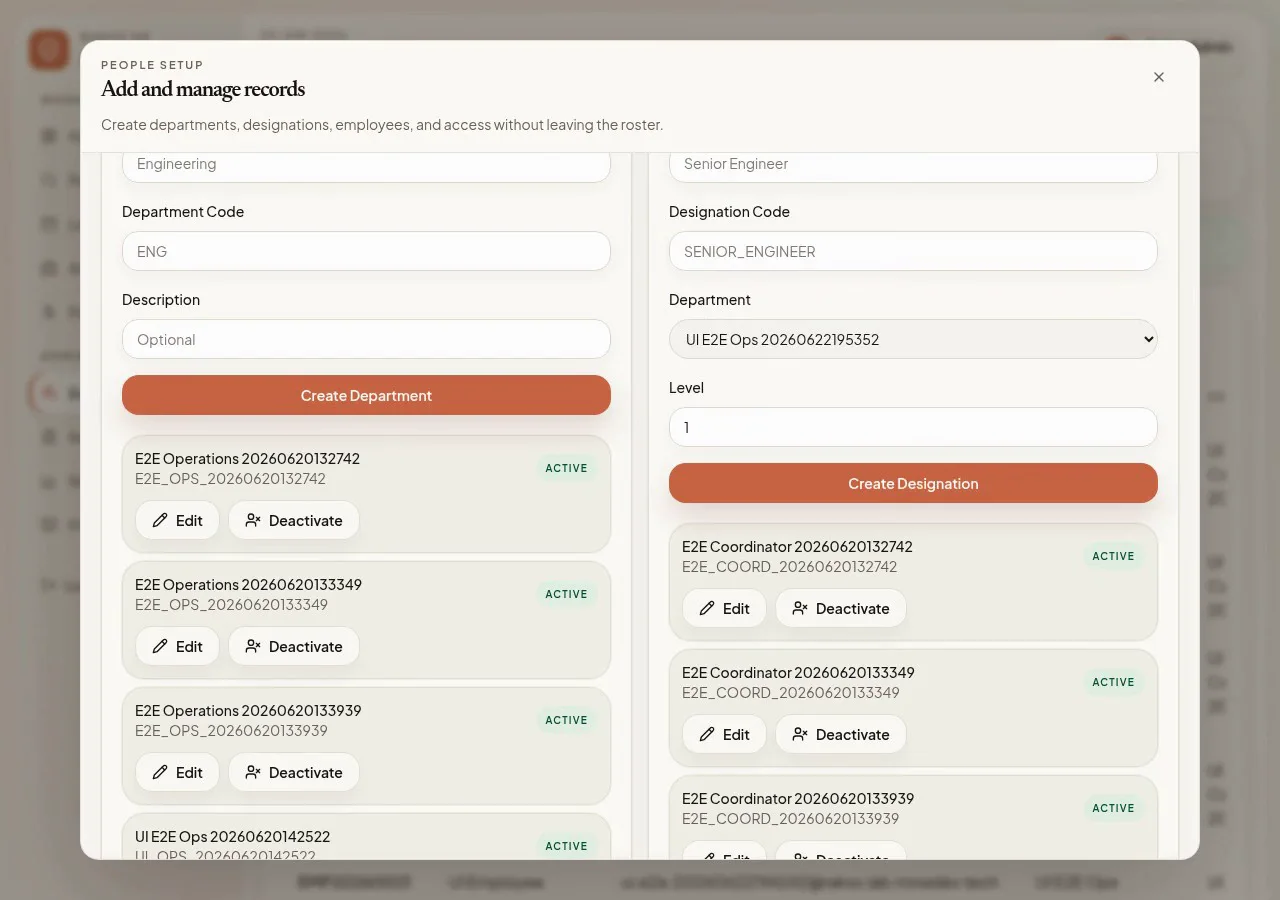
A public-safe excerpt from the verified deployed-site lifecycle recording. It follows organization setup, employee creation and readback, staff access, and the start of the attendance workflow using generated records.
Architecture and API proof
One data model across operator and employee workflows.
Sanitized from the implemented project structure and employee-directory GraphQL contract.
Operator surface
React admin portal
Records, approvals, payroll, policies, and reports
Employee surface
Expo mobile app
Attendance, requests, balances, and documents
Application boundary
NestJS GraphQL API
Shared records
PostgreSQL
One operational model for people, roles, attendance, leave, payroll, documents, and reporting.
Docker-based development runtime
Sanitized API sample
Employee directory query
A reduced read-only selection from the implemented admin query. It shows typed filtering and joined organizational data without exposing authentication, endpoints, IDs, or real employee information.
query EmployeeDirectory($filter: EmployeeFilterInput) {
  employees(filter: $filter) {
    employeeNumber
    fullName
    status
    department { name }
    designation { title }
  }
}01 / Challenge
The workflow before the system
HR administration often joins records, attendance, leave, payroll support, documents, and management follow-up across separate files and tools.
02 / Approach
How I designed the response
I independently designed a modular NestJS and GraphQL backend, React admin portal, Expo mobile app, and PostgreSQL data model around those connected workflows.
03 / Outcome
Delivered an integrated HR workflow across backend, admin, mobile, PostgreSQL, role-based access, employee records, attendance, leave, payroll, policies, and reporting, verified through a generated-data lifecycle walkthrough.
04 / Workflow
Before
- Records and follow-up are split across files and separate tools
- Attendance, leave, payroll support, and documents require manual reconciliation
- Reporting depends on repeated cleanup
With the system
- Configure companies, departments, roles, and employee records
- Record attendance and submit requests through bounded workflows
- Review approvals, balances, documents, payroll records, and reports
- Use generated demonstration data for public-safe lifecycle verification
05 / Engineering proof
Architecture
- Bun workspace with NestJS GraphQL backend, React admin portal, and Expo mobile app
- Modular monolith structure for bounded HR domains
- PostgreSQL-backed runtime with Docker-based development
- Separate web-admin and mobile surfaces over shared backend workflows
Verified evidence
- Repository documents the backend, admin, mobile, database, and verification commands
- Implemented modules cover authentication, employees, attendance, leave, payroll, policies, and reporting
- A deployed Admin CP lifecycle walkthrough was verified with generated data
06 / Judgment
Tradeoffs
- A modular monolith keeps deployment practical while preserving domain boundaries
Why it matters
- Models fragmented HR administration as one connected workflow
- Demonstrates backend, web, mobile, and data-model ownership
- Shows practical business-software engineering without relying on AI as the headline
What this proves
I can independently design and build full-stack business software across backend, web, mobile, records, roles, approvals, and reporting.
Continue exploring